Every October, the same question starts coming into American window-treatment showrooms: “Do you have anything that actually cuts the heating bill?” This year, the question is louder than usual. The U.S. Energy Information Administration’s 2026–27 Winter Fuels Outlook — published October 6, 2026 — projects heating-oil households will pay about $2,115 for the November–March season, up 21% from last year, while electric-heat homes face a 4% increase to roughly $1,196. Homeowners and property managers are doing the math, and dealers who can answer with a product backed by hard data — not marketing claims — will win the winter.
That product is the energy efficient cellular shade. The U.S. Department of Energy (DOE) identifies properly fitted cellular shades as the window treatment with the highest insulating value of any shade type on the market. This guide walks you through the verified numbers, the specs that matter, and how to stock and sell energy efficient cellular shades for the 2026–27 season — whether you serve retail customers, designers, or commercial projects.
The Timing: Why This Winter Is the Window
Window-treatment demand is seasonal, and insulation-driven demand is the most predictable kind. Three conditions are converging right now:
- Bills are rising. EIA’s October 2026 outlook puts heating-oil households at $2,115 for the season (+21%, concentrated in the Northeast) and electric-heat homes at $1,196 (+4%). When the first cold snap lands in November, the phone calls start.
- Stocking lead time matters. A dealer ordering now has product on the shelf when the demand peaks in December–January. Ordering in December means missing the season.
- The renovation wave compounds it. U.S. hospitality capital is flowing into property refreshes rather than new builds in 2026–27 (see our hotel renovation window treatments guide). Renovations are natural moments to upgrade to insulating window treatments — owners can fold the energy payback into the project’s ROI model.
The takeaway: energy efficient cellular shades are not a “nice to have” line item for this season. For dealers and project suppliers, they are the product that matches the customer’s single most urgent winter question.
How Cellular Shades Actually Save Energy
The physics is straightforward, and it is worth understanding so you can explain it to customers without hand-waving.
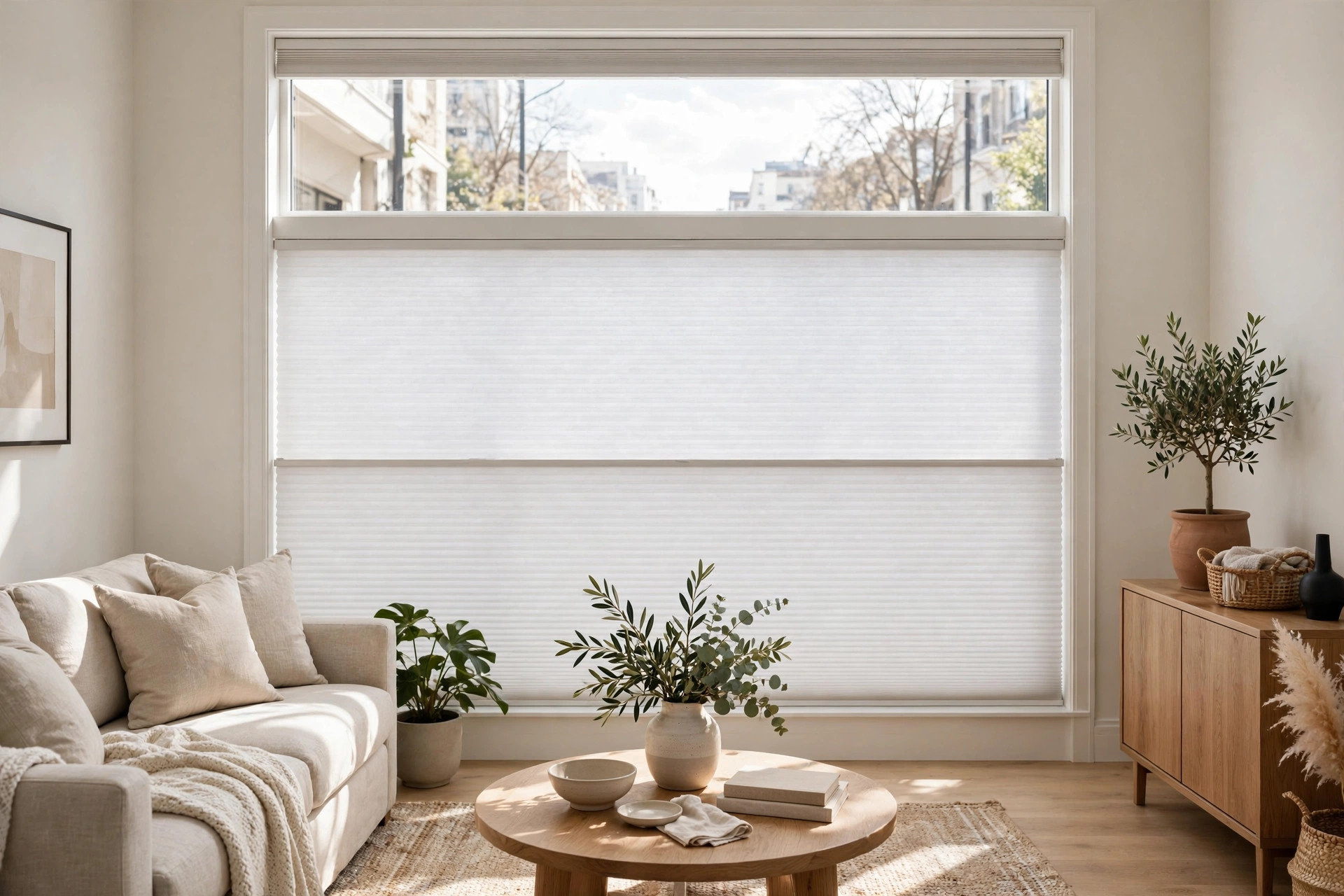
A cellular (honeycomb) shade is built from bonded fabric cells that trap air in pockets when the shade is lowered. Still air is a poor conductor of heat, so each cell becomes a small insulating layer between the room and the glass. This is why the DOE rates cellular shades as the highest-R-value window treatment available — nothing else you hang on a window adds an insulating air layer the same way.
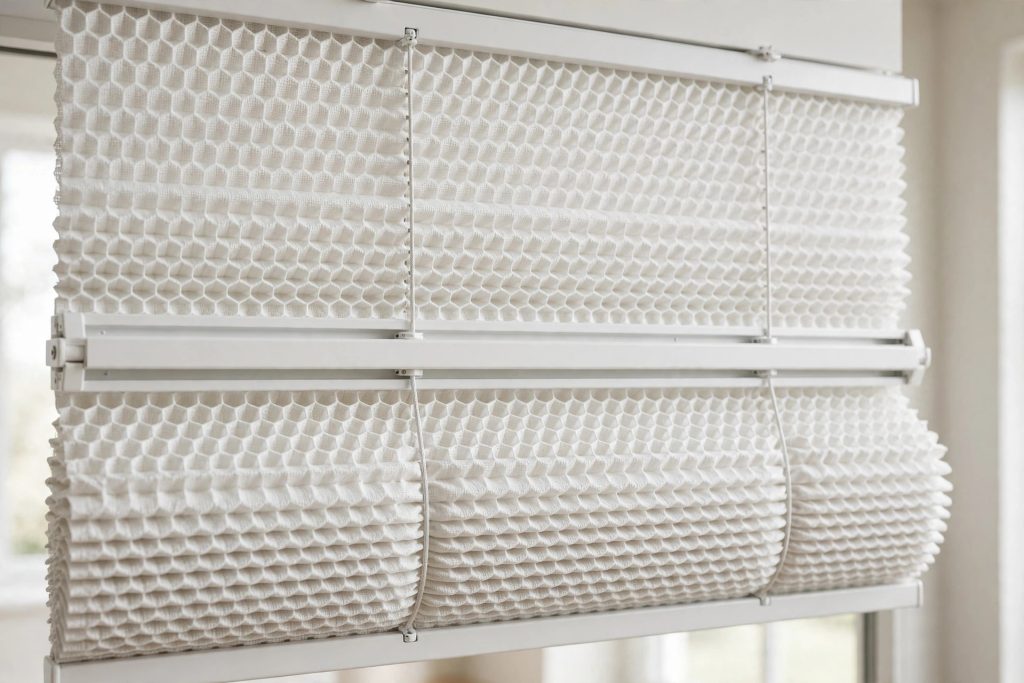
Here are the DOE’s verified figures for tightly installed cellular shades — and the “tightly installed” condition matters; it is the fitting, not just the product, that delivers these results:
- Heating season: heat loss through windows drops by more than 40%, which works out to roughly 10% savings on total heating energy.
- Cooling season: unwanted solar heat gain drops by up to 60%, with total solar heat gain falling to about 20% when shades are fitted tightly.
The DOE also reports two facts that turn directly into selling points:
- About 30% of a home’s heating energy is lost through windows. That single sentence reframes the shade from a decor item to a building-envelope product in the customer’s mind.
- 75% of U.S. households leave their window treatments in the same position all day. Which means the insulation is often wasted — shades closed on a sunny winter afternoon block free solar heat; shades open on a hot summer afternoon admit it. This is the opening for motorized, scheduled operation (more on that below).
Single cell vs. double cell: double-cell (two layers of honeycomb) traps more air and generally insulates better, while single-cell keeps a slimmer profile and lower price point. For wholesale stocking, the typical split is: double-cell blackout for bedrooms and high-bill regions, single-cell light-filtering for living areas. Ask your factory for the fabric weight and cell size options before committing — these details affect both performance and folded stack height.
Installation Details That Make or Break the R-Value
The DOE’s 40%+/10% numbers come with a condition — tight installation — so the mounting details are not cosmetic; they are the difference between the claimed performance and a disappointing result:
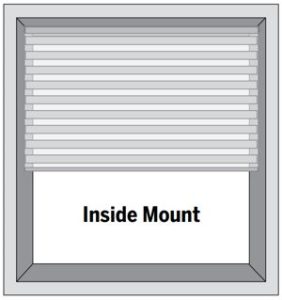
- Inside mount with minimal gaps. A shade that covers the window opening fully, with small light gaps on the sides, traps air far better than one that floats well outside the frame.
- Side tracks for maximum effect. The DOE specifically notes that cellular shades with side tracks are the most effective installation method for boosting a window’s R-value. For commercial projects and high-bill regions, specify side channels.
- Top-down/bottom-up for daylighting. The DOE calls top-down/bottom-up the best configuration for daylight control — lower the shade from the top for privacy while light enters over it. This matters for the energy story because it lets the shade stay in its insulating position while still admitting daylight, instead of being raised (and de-insulated) every morning. Our top-down/bottom-up cellular shades guide covers the wholesale sourcing side in detail.
When a customer asks why their neighbor’s cellular shades “didn’t do much,” the answer is almost always fit, not fabric.
The Motorized Advantage: Turning 75% Into Savings
The DOE’s finding that three-quarters of households never move their shades during the day points to the single biggest upgrade in the energy story: automation.
A motorized cellular shade on a schedule does what people won’t do manually — open south- and west-facing shades on winter mornings to admit free solar heat, close them at dusk to trap it; close east-facing shades on summer afternoons to block heat gain. The shade becomes a passive solar manager, not a static blind.
For dealers, motorized cellular shades also solve two other objections at once:
- Child and pet safety. Motorized means cordless — no loop cords, which matters for U.S. buyers under the country’s child-safety expectations for window coverings. Cordless is already a baseline requirement for many schools, daycares, and family housing projects.
- Accessibility and luxury positioning. Remote or app control is a standard expectation in the premium segment; offering it lets you quote the same insulating product at a higher ticket.
Sunjoy Shades supplies motorized honeycomb shades with built-in rechargeable battery motors — remote-controlled, with multi-channel remotes able to group up to 16 shades, and app control available on request. No hardwiring means they retrofit into existing buildings, which is exactly what renovation and energy-retrofit projects need.
Specs That Matter for Commercial and Project Buyers
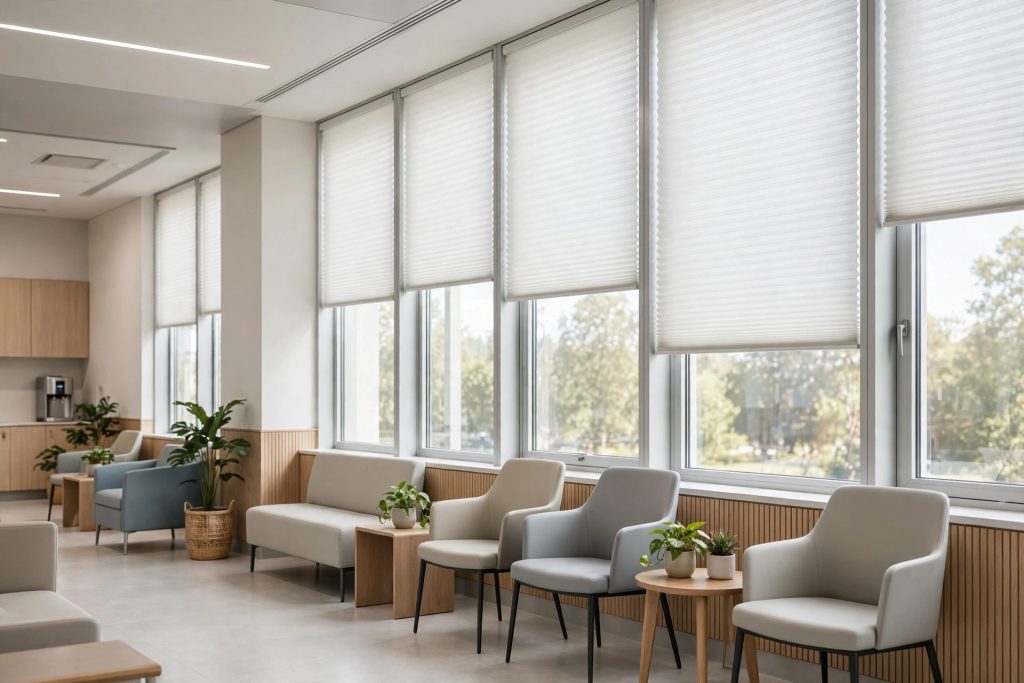
Residential dealers can sell on the DOE numbers alone. Commercial buyers — hotels, offices, schools, hospitals — need compliance specs alongside performance. Before quoting a project, confirm these:
- Flame-retardant rating. U.S. commercial and hospitality projects typically require NFPA 701 certification on window-treatment fabrics. If your project is a hotel, hospital, or public building, ask the factory for the fabric’s flame-retardant documentation before you specify — retrofitting certification after the order is placed is painful.
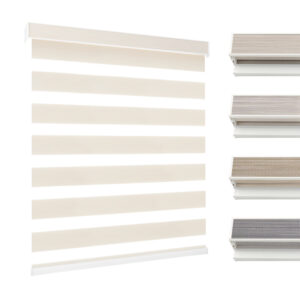
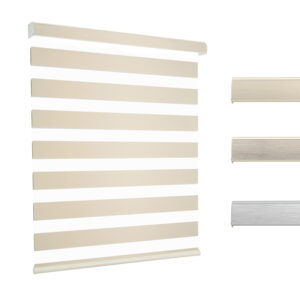
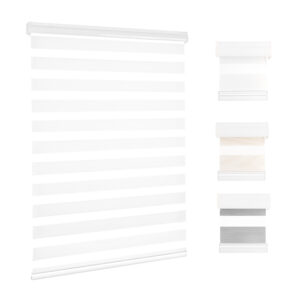
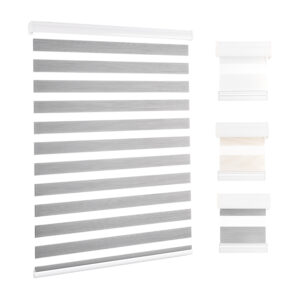
- Blackout vs. light-filtering. Guest rooms need blackout (and blackout cellular shades with side tracks are the strongest energy story for hotels); offices and lobbies usually want light-filtering to preserve daylight. Sunjoy Shades offers both, including day-and-night cellular options that combine sheer and blackout fabric in one shade — see the day-and-night cellular shades line.
- Cordless / motorized for safety. Schools, daycares, and family-housing projects increasingly require cordless operation. Motorized or cordless-spring cellular shades check this box while keeping the energy pitch.
- Custom sizing. Commercial openings are rarely standard. A factory that cuts to custom width and height — rather than selling fixed sizes — is the difference between a clean install and a field-measure headache. Confirm the factory’s size range and tolerance before quoting.
How to Sell the Energy Story (Dealer Script)
Your customers are not buying “R-value.” They are buying lower bills and a warmer house. Translate the DOE data into their language:
- Lead with the bill, not the fabric. “Heating-oil households are looking at about $2,115 this winter — up 21%. A tightly fitted cellular shade cuts window heat loss by over 40%, which the Department of Energy equates to roughly 10% off the heating bill.” That is a payback story, not a decor story.
- Use the 30% figure. “About a third of your home’s heating energy leaves through the windows. This is the cheapest place in the house to add insulation.”
- Sell the schedule, not just the shade. For motorized quotes, explain the 75% problem: “Most people never move their shades during the day, so the insulation sits wasted. A scheduled motor puts them where they should be — open for winter sun, closed for summer afternoons.”
- Bundle for projects. In renovation and retrofit bids, pair the shades with side tracks and motorization, and put the energy payback in the bid summary. Owners evaluating a PIP or energy retrofit respond to line items with ROI math attached.
Wholesale Sourcing Checklist
If you are adding energy efficient cellular shades to your line for this season, here is what to lock down with your factory before you place the order:
- Cell structure options — single cell, double cell, and day-and-night; fabric weights and colors in stock.
- Operation types — cordless spring, chain, and motorized (rechargeable battery, remote + optional app).
- Mounting accessories — side tracks/side channels for the full R-value installation; confirm availability and lead time.
- Compliance documentation — NFPA 701 flame-retardant data for the fabrics you plan to sell into commercial projects.
- MOQ and lead time — confirm minimum order quantities per color/size and the production window; order now to land before the December demand peak.
- OEM and private label — if you sell under your own brand, confirm the factory supports private labeling on packaging and remotes.
- Samples — request fabric swatches and a working sample shade; the cell structure sells itself in person. Ask about the factory’s free-sample policy.
Shaoxing Sunjoy Group Co., Ltd. (sunjoyshades.com) manufactures roller, zebra, honeycomb/cellular, Shangri-La, and dream shades for wholesale buyers — motorized and cordless options, custom sizes, OEM/private label — from its factory in Shaoxing, China, since 2009. Designers and contractors can also check our trade program for project pricing support.
FAQ
Do cellular shades really reduce heating bills?
The U.S. Department of Energy states that tightly installed cellular shades reduce heat loss through windows by more than 40%, equating to roughly 10% savings on total heating energy. The key condition is tight installation — a well-fitted shade with minimal side gaps (ideally with side tracks) delivers the result; a loose fit does not.
Are cellular shades better insulators than roller shades?
Yes. The DOE rates cellular shades as the highest-R-value window treatment available, because the honeycomb cells trap insulating air. A standard roller shade is a single fabric layer with no trapped-air structure, so it insulates far less. For customers whose priority is energy savings, cellular is the right recommendation.
Single cell or double cell — which should I stock?
Double cell generally insulates better (more trapped air) and suits bedrooms and cold-climate regions; single cell is slimmer, lighter, and cheaper, fitting living areas and budget lines. Most dealers stock both, plus a blackout option for bedrooms.
Do I need motorized shades for the energy benefit, or is manual enough?
Manual shades deliver the full insulating benefit whenever they are in the lowered position. Motorized adds the scheduling benefit: the DOE found 75% of households never move their shades during the day, so automation captures the solar-gain timing that manual operation usually misses. It is an upgrade, not a requirement.
Can cellular shades be used in hotels and commercial projects?
Yes, with the right specs. Confirm NFPA 701 flame-retardant documentation for the fabric, specify blackout cellular shades with side tracks for guest rooms (strongest energy and sleep story), and use custom sizing for non-standard commercial openings.
What is the typical lead time for wholesale cellular shade orders?
Lead times vary by factory, season, and order complexity — custom sizes, motorization, and private labeling all add time. For the 2026–27 heating season, place orders in October to have stock on hand for the December–January demand peak. Ask your factory for its current production schedule and sample policy before committing.
Get a Free Wholesale Quote
Stocking energy efficient cellular shades before the heating season peaks is one of the simplest inventory bets a dealer can make this year — the demand is driven by utility bills, not fashion cycles.
Get a Free Wholesale Quote — tell us your sizes, quantities, cell structure, and operation type, and we’ll respond with factory-direct pricing, MOQ, and lead time.
WhatsApp: +86 18706580010
About Sunjoy Shades
Sunjoy Shades (Shaoxing Sunjoy Group Co., Ltd., sunjoyshades.com) has manufactured window blinds and shades since 2009 at its factory in Shaoxing, China. The company supplies roller shades, zebra (day-and-night) shades, honeycomb/cellular shades, Shangri-La shades, and dream shades to wholesalers, dealers, designers, and project buyers across North America — with motorized and cordless options, custom sizing, OEM/private label service, and free samples. WhatsApp: +86 18706580010.